
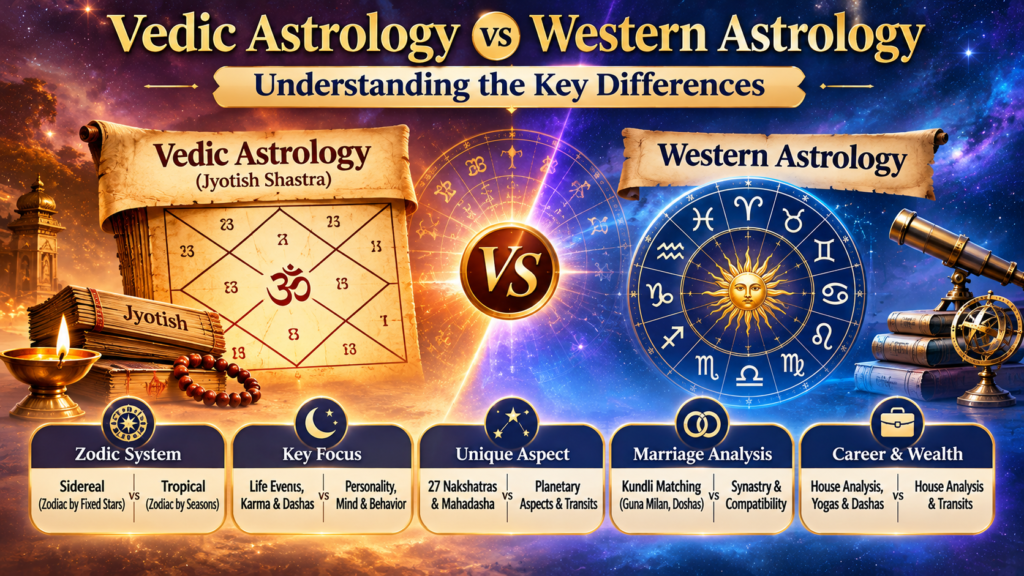
Vedic Astrology vs Western Astrology: Understanding the Key Differences
Introduction
Astrology has fascinated people for thousands of years. Across different cultures and civilizations, people have looked towards the stars and planets to understand their personalities, relationships, career opportunities, and life experiences.
Two of the most popular astrological systems in the world are Vedic Astrology and Western Astrology. Although both systems study the movements and positions of celestial bodies, they follow different calculation methods, zodiac systems, and interpretation techniques.
Vedic Astrology, also known as Jyotish Shastra, originated in ancient India and is deeply connected with traditional Indian philosophy and spiritual knowledge. Western Astrology developed through ancient Greek, Babylonian, and later European traditions.
But what exactly makes these two systems different? Which one focuses more on planetary periods, and which one places greater emphasis on personality and psychological patterns?
In this blog, we will explore the major differences between Vedic Astrology and Western Astrology and understand how both systems interpret different aspects of human life.
1. What Is Vedic Astrology?
Vedic Astrology, commonly known as Jyotish Shastra, is an ancient Indian astrological system used to study planetary positions and their traditional associations with human life.
The word Jyotish means the science of light. It is traditionally considered a part of the ancient Indian knowledge system and is used for horoscope analysis, marriage compatibility, career guidance, financial tendencies, and spiritual development.
Vedic Astrology primarily uses the Sidereal Zodiac, which considers the positions of zodiac signs in relation to fixed stars.
Important Features of Vedic Astrology
Birth Chart (Kundli): A horoscope prepared using an individual’s date, time, and place of birth.
12 Houses: Each house represents different aspects of life, such as career, marriage, wealth, family, and spirituality.
Nine Grahas: Sun, Moon, Mars, Mercury, Jupiter, Venus, Saturn, Rahu, and Ketu.
27 Nakshatras: Lunar constellations used for detailed horoscope interpretation.
Mahadasha System: Planetary periods used to interpret different phases of life.
Yogas and Doshas: Specific planetary combinations traditionally associated with different life experiences.
Vedic Astrology places considerable importance on planetary periods, Nakshatras, house placements, and planetary relationships.
2. What Is Western Astrology?
Western Astrology is a popular astrological system primarily used in Europe, North America, and other parts of the world.
It generally uses the Tropical Zodiac, which is based on the relationship between the Sun and the Earth’s seasonal cycle.
Western Astrology is widely known for zodiac sign predictions, personality analysis, compatibility readings, and horoscope interpretations.
Important Features of Western Astrology
Sun Sign: Represents the zodiac sign occupied by the Sun at birth.
Moon Sign: Traditionally associated with emotions and inner personality.
Rising Sign (Ascendant): Represents the zodiac sign rising on the eastern horizon at birth.
12 Zodiac Signs: Aries, Taurus, Gemini, Cancer, Leo, Virgo, Libra, Scorpio, Sagittarius, Capricorn, Aquarius, and Pisces.
12 Astrological Houses: Represent different areas of personal and professional life.
Planetary Aspects: Examine angular relationships between planets.
Transits: Study how current planetary movements relate to the birth chart.
Western Astrology often places significant emphasis on personality, psychological tendencies, relationships, and personal development.
3. Major Differences Between Vedic Astrology and Western Astrology
Although both systems study planetary movements, their approaches differ in several important ways.
A. Sidereal Zodiac vs Tropical Zodiac
One of the biggest differences between Vedic and Western Astrology is the zodiac system they use.
Vedic Astrology – Sidereal Zodiac
Vedic Astrology generally follows the Sidereal Zodiac, which is aligned with the positions of fixed stars and constellations.
It uses an adjustment known as Ayanamsa to account for the difference between the tropical and sidereal reference systems.
Western Astrology – Tropical Zodiac
Most traditional Western Astrology follows the Tropical Zodiac, which is connected to the Earth’s seasons and the position of the Sun at the March equinox.
Because these systems use different reference points, a person’s zodiac sign may differ between Vedic and Western birth charts.
For example, someone who has a Taurus Sun sign in Western Astrology may have an Aries Sun sign in Vedic Astrology, depending on their birth date and the Ayanamsa used.
B. Importance of the Moon Sign and Sun Sign
Both systems consider the Sun and Moon important, but their traditional emphasis differs.
Vedic Astrology
Vedic Astrology gives considerable importance to the Moon sign, known as Chandra Rashi, and the Nakshatra in which the Moon is placed.
These are important in traditional horoscope interpretation and the calculation of Vimshottari Dasha periods.
Western Astrology
Western Astrology commonly gives strong importance to the Sun sign when discussing personality and general horoscope predictions.
However, detailed Western birth chart readings also examine the Moon sign, Ascendant, and other planetary placements.
C. Nakshatras in Vedic Astrology
One of the distinctive features of Vedic Astrology is its use of 27 Nakshatras.
Nakshatras are lunar constellations that divide the zodiac into 27 sections.
Each Nakshatra has its own ruling planet and traditional symbolism.
Some important Nakshatras include:
Ashwini
Bharani
Krittika
Rohini
Mrigashira
Ardra
Pushya
Magha
Hasta
Swati
Anuradha
Revati
Nakshatras are traditionally used to understand personality tendencies, relationship compatibility, planetary periods, and other horoscope factors.
Western Astrology does not generally use the same 27-Nakshatra framework in its mainstream practice.
D. Mahadasha System vs Planetary Transits
Another major difference is how both systems interpret timing and life events.
Vedic Astrology – Mahadasha and Antardasha
The Vimshottari Dasha system is one of the most widely used timing systems in Vedic Astrology.
It divides life into major planetary periods called Mahadashas and sub-periods called Antardashas.
Each planetary period is interpreted according to the planet’s position, strength, house ownership, and relationship with other planets in the birth chart.
Western Astrology – Transits and Progressions
Western Astrology commonly uses planetary transits and secondary progressions to study different phases of life.
Transits examine how current planetary positions relate to the positions of planets in the birth chart.
Secondary progressions use a symbolic timing method to interpret personal development and changing life themes.
E. Rahu and Ketu
Vedic Astrology gives special importance to Rahu and Ketu, which are the north and south lunar nodes.
These are mathematical points where the Moon’s orbital path intersects the ecliptic, rather than physical planets.
In Vedic Astrology, Rahu and Ketu are traditionally associated with ambition, desires, spiritual lessons, detachment, and karmic themes.
Western Astrology also studies the North Node and South Node, although their interpretations and use can differ between astrological traditions.
4. Difference in Birth Chart Preparation
Both systems prepare a birth chart using the date, exact time, and place of birth. However, their chart calculations and presentation methods can differ.
Vedic Birth Chart (Kundli)
A Vedic birth chart generally includes:
Lagna or Ascendant.
Planetary positions in zodiac signs.
Twelve houses.
Nakshatras and their rulers.
Planetary aspects.
Yogas and Doshas.
Mahadasha and Antardasha periods.
Divisional charts.
Common Vedic chart formats include North Indian, South Indian, and East Indian styles.
Western Birth Chart
A Western birth chart generally includes:
Sun sign.
Moon sign.
Ascendant or Rising sign.
Planetary positions.
Twelve houses.
Major and minor aspects.
Zodiac modalities and elements.
Transits and progressions.
Western birth charts are commonly displayed as circular horoscope wheels.
5. Vedic Astrology vs Western Astrology for Marriage and Relationships
Marriage and relationships are important areas in both astrological systems.
However, the methods used to examine relationship compatibility can differ.
Marriage Analysis in Vedic Astrology
Vedic Astrology traditionally examines several factors before interpreting marriage-related matters.
These include:
7th house and its ruling planet.
Venus and Jupiter.
Navamsa Chart (D9).
Manglik Dosha.
Ashtakoota Guna Milan.
Nadi and Bhakoot compatibility.
Relevant planetary Dashas.
Kundli matching is a traditional practice used to compare two birth charts before marriage.
Relationship Analysis in Western Astrology
Western Astrology commonly uses Synastry and Composite Charts.
Synastry: Compares the planetary positions of two individuals to explore relationship dynamics and compatibility.
Composite Chart: Creates a combined chart using the midpoints of corresponding planetary positions to symbolically examine the relationship itself.
Both systems provide different traditional approaches to understanding relationships and compatibility.
6. Which Astrology System Is Better for Career and Financial Analysis?
Both Vedic and Western Astrology offer methods for interpreting professional and financial themes.
Career and Wealth in Vedic Astrology
Vedic Astrology traditionally examines:
2nd House: Savings and accumulated wealth.
5th House: Intelligence and speculation.
9th House: Fortune and opportunities.
10th House: Career and profession.
11th House: Income and financial gains.
It also examines planetary Yogas, Dashas, and the Dashamsa Chart (D10) for professional analysis.
Career and Wealth in Western Astrology
Western Astrology commonly examines:
2nd House: Personal finances and resources.
6th House: Work and daily responsibilities.
8th House: Shared resources and investments.
10th House: Career and public reputation.
11th House: Income, networks, and aspirations.
Planetary transits and aspects are also considered when interpreting professional and financial developments.
Neither system can guarantee career success or financial prosperity. Practical decisions, education, financial planning, and personal efforts remain important.
7. Can You Follow Both Vedic and Western Astrology?
Yes. Many astrology enthusiasts explore both systems to understand different approaches to interpreting their birth charts.
Vedic Astrology offers traditional techniques involving Nakshatras, Dashas, Yogas, and divisional charts.
Western Astrology offers techniques involving the Tropical Zodiac, planetary aspects, transits, and psychological interpretations.
Some people find it useful to compare the two systems, provided they understand that their calculations and interpretive frameworks are different.
It is important not to mix chart calculations or interpretations without understanding the principles behind each system.
8. How to Choose Between Vedic Astrology and Western Astrology?
Choosing an astrological system depends on your interests and the type of traditional interpretation you want to explore.
You may consider Vedic Astrology if you are interested in:
Traditional Kundli analysis.
Nakshatra-based interpretations.
Mahadasha and Antardasha.
Kundli matching and marriage compatibility.
Vedic Yogas and Doshas.
Traditional spiritual and astrological practices.
You may explore Western Astrology if you are interested in:
Sun, Moon, and Rising sign analysis.
Personality and psychological interpretations.
Planetary aspects.
Relationship Synastry.
Transits and progressions.
Personal development themes.
Both systems have long histories and distinct interpretive traditions.
9. Explore Vedic Astrology with Power of Shivnandani
Understanding astrology requires more than simply knowing your zodiac sign. A detailed birth chart involves examining planetary positions, house placements, aspects, Nakshatras, and other astrological factors.
At Power of Shivnandani, we offer traditional Vedic Astrology and personalised consultation services to help individuals explore their birth charts and understand different aspects of life.
Our services include:
Vedic Astrology Consultation.
Detailed Kundli Analysis.
Career and Business Astrology.
Marriage and Relationship Astrology.
Kundli Matching.
Financial and Wealth Astrology.
Planetary Dasha Analysis.
Nadi Shastra.
Vastu Consultation.
Mantra and Yantra Guidance.
Our approach focuses on personalised astrological interpretation based on individual birth details and specific concerns.
Conclusion
Vedic Astrology and Western Astrology are two different systems that share an interest in understanding the relationship between celestial movements and human experiences.
While Vedic Astrology primarily uses the Sidereal Zodiac and places significant emphasis on Nakshatras, Dashas, and traditional Kundli analysis, Western Astrology generally follows the Tropical Zodiac and focuses on planetary aspects, transits, and personality interpretations.
Neither system needs to be considered universally superior. Each has its own traditions, methods, and interpretive strengths.
If you are interested in exploring your birth chart through traditional Indian astrology, Vedic Astrology can offer a detailed framework for understanding planetary placements and their traditional significance.
Power of Shivnandani – Discover the Wisdom of Vedic Astrology and Explore Your Cosmic Journey.
For personalised Vedic Astrology and Kundli Consultation, connect with Power of Shivnandani.
Frequently Asked Questions (FAQs)
1. What is the main difference between Vedic Astrology and Western Astrology?
The main difference is their zodiac calculation system. Vedic Astrology generally uses the Sidereal Zodiac, while Western Astrology commonly uses the Tropical Zodiac.
2. Why are zodiac signs different in Vedic and Western Astrology?
The difference occurs because the two systems use different reference points. Vedic Astrology accounts for the difference through Ayanamsa, while Western Tropical Astrology is based on the seasonal cycle.
3. Which astrology system uses Nakshatras?
Vedic Astrology uses 27 Nakshatras to interpret lunar positions, planetary influences, and traditional horoscope factors.
4. Does Western Astrology use Rahu and Ketu?
Western Astrology studies the North Node and South Node, which correspond to Rahu and Ketu, although their interpretations may differ.
5. Which astrology system is used for Kundli matching?
Traditional Kundli matching is primarily associated with Vedic Astrology. It commonly involves Guna Milan, Nadi Dosha, Bhakoot, Manglik Dosha, and other horoscope factors.
6. Can I use both Vedic and Western Astrology?
Yes. You can explore both systems to understand their different approaches, provided you keep their zodiac calculations and interpretive methods distinct.