
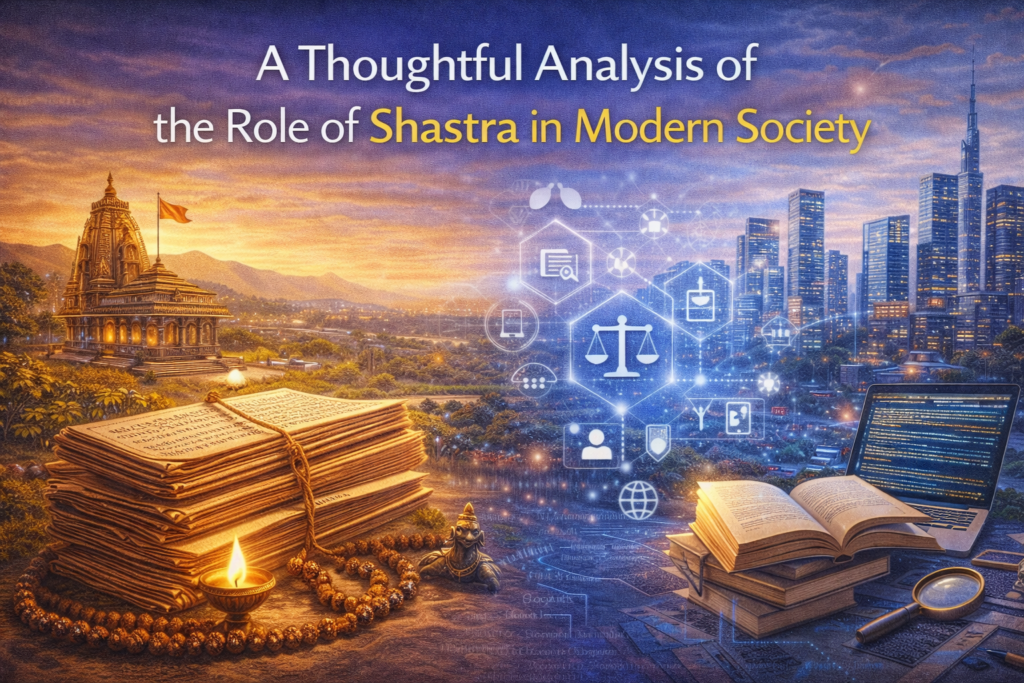
A Thoughtful Analysis of the Role of Shastra in Modern Society
In an age defined by rapid technological progress, global connectivity, and shifting cultural values, a profound question arises: What is the role of Shastra in modern society?
Shastras—ancient Indian scriptures encompassing philosophy, ethics, law, spirituality, architecture, governance, and daily living—were once the foundation of civilization. Today, while modern systems dominate public life, the wisdom of Shastra continues to offer insights that remain deeply relevant.
This article explores how Shastra can guide, enrich, and coexist with modern society.
What Is Shastra?
The word Shastra comes from the Sanskrit root “shas”, meaning “to instruct” or “to discipline.” Shastras are authoritative texts that provide guidance on:
Dharma (righteous conduct)
Artha (material prosperity)
Kama (desire and fulfillment)
Moksha (liberation)
They include:
Dharmashastra (ethics & law)
Arthashastra (governance & economics)
Vastu Shastra (architecture)
Natya Shastra (arts)
Yoga Shastra (self-realization)
Shastra is not merely religious—it is civilizational knowledge.
Shastra as a Moral Compass
Modern society faces ethical dilemmas:
Corporate greed
Environmental damage
Social inequality
Digital misuse
Shastra emphasizes Dharma as the guiding principle.
It teaches that actions must align with:
Truth
Responsibility
Social harmony
Long-term welfare
In a world driven by speed and profit, Shastra reminds us of ethical accountability.
Governance & Leadership Lessons
Ancient texts like Arthashastra provide structured frameworks for:
Statecraft
Economic management
Public welfare
Security
While political systems have evolved, the principles of:
Justice
Transparent leadership
Citizen welfare
remain timeless.
Modern governance can benefit from these foundational ideas without abandoning democratic systems.
Role in Personal Development
Shastra emphasizes inner discipline and self-awareness.
In today’s world of anxiety and stress:
Yoga Shastra promotes balance
Vedantic teachings cultivate clarity
Meditation enhances focus
Modern psychology increasingly validates practices rooted in ancient Shastra.
Science & Spiritual Harmony
Contrary to common misconceptions, Shastra does not reject rational inquiry. Many classical texts encourage observation, reasoning, and structured knowledge.
For example:
Ayurveda integrates holistic health principles
Vastu Shastra studies spatial harmony
Jyotish integrates cosmic observation
Modern science and Shastra can engage in dialogue rather than conflict.
Social Order & Responsibility
Shastra traditionally emphasized:
Duty before rights
Community harmony
Respect for elders and teachers
Ecological responsibility
Modern society often emphasizes individual freedom—but sometimes at the cost of collective responsibility.
Shastra offers a balanced perspective where rights and duties coexist.
Misinterpretations & Modern Challenges
It is important to acknowledge that:
Some Shastric interpretations were misused historically
Social contexts have changed
Literal application without understanding can create conflict
Therefore, the key is not blind adherence—but contextual understanding and reinterpretation.
Shastra should be studied with:
Critical thinking
Compassion
Relevance to present times
Shastra in the Digital Age
Interestingly, technology is reviving Shastra:
Digital archives of manuscripts
Online Sanskrit courses
Virtual spiritual discussions
Global accessibility to ancient texts
Modern tools are helping preserve ancient wisdom.
Integration, Not Opposition
The question is not whether Shastra replaces modern systems—but whether it can enrich them.
Modern society needs:
Ethical grounding
Cultural continuity
Psychological stability
Ecological sensitivity
Shastra provides philosophical depth that complements modern progress.
The Way Forward
A thoughtful integration of Shastra in modern society requires:
Educational inclusion of ethical philosophy
Research-based reinterpretation
Dialogue between tradition and modern disciplines
Application of principles—not rigid rituals
When understood correctly, Shastra becomes a living guide—not a relic of the past.
Final Reflection
Shastra is not about returning to the past. It is about drawing timeless wisdom into present reality.
In a world that moves fast but often lacks direction, Shastra offers depth, clarity, and balance. Modern society may change in form, but the human need for meaning, ethics, and harmony remains constant.
Thus, the role of Shastra today is not to dominate—but to guide. Not to restrict—but to illuminate.
When wisdom and progress walk together, civilization truly advances.